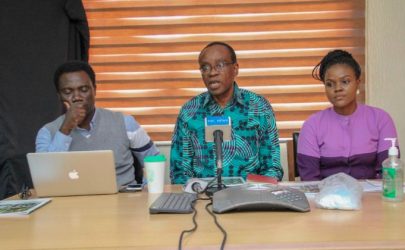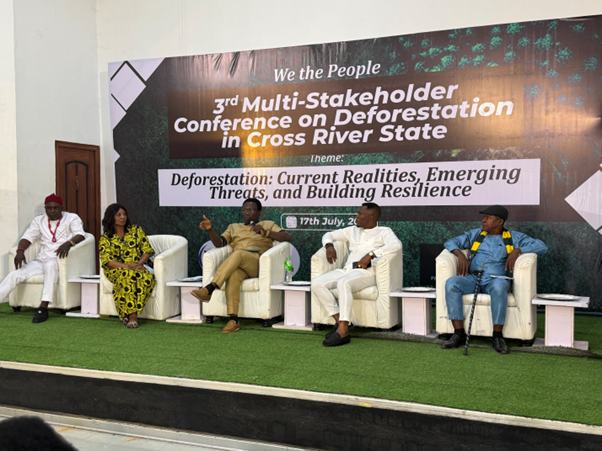
On July 17, 2025, We the People held the 3rd edition of its annual Multi-Stakeholder Conference on Deforestation in Cross River state. The conference which held in Calabar, Cross River State brought together stakeholders such as community leaders, conservationists, public officials, legal practitioners, academics and members of the media. The meeting focused on highlighting the increasing threat of deforestation in Cross River State, assessing the limitations and challenges related to government responses, exploring policy alternatives to halt forest loss in the area, emphasize strategies for wildlife protection, empower communities to safeguard the forests, and developing long-term approaches for multi-stakeholder collaboration on forest conservation.
In his opening address Executive Director of We the People, Ken Henshaw highlighted the fact that the rate of forest loss in Cross River State was probably the fastest rate globally. According to him, efforts by the government in the last 16 years to stop deforestation had instead served to exacerbate the problem. “In 2008, inspired by the promise of carbon credits through the UN REDD+ scheme, the government of Cross River State took radical decisions on its forest including the reversal of community forest ownership rights, and the introduction of a ban on forest activities. This ban not only questioned the right of indigenous people over their own forest resources, but also alienated them from acting as protectors of the forests against illegal loggers. Rather than stop illegal logging, it made logging more lucrative and widespread. This is certainly what made the government to rescind the ban in 2023” he said.
In his keynote presentation, Dr. Nnimmo Bassey of the Health of Mother Earth Foundation highlighted the need for forests to be protected at all cost, for the sake of combating climate change. According to him, governments were commodifying the forest and utilizing it as another source of revenue to service the budget. He equally questioned the logic of converting forests to cocoa or palm plantations, saying that while plantations were green, they could not be equated to forests.
Leading a Panel discussion, Dr. Martins Ego of PADIC-Africa identified the gaps in the Cross River State Forestry Law of 2007 as one of the key barriers to effective protection of the state’s forests. According to him, the law is outdated and insufficient to address the myriad challenges facing the state’s forests. He called on the state government to initiate plans to review the state Forestry law towards making it more effective for protecting the forests, and bringing it into sync with other national laws and international frameworks on climate change and energy transition.
The second Panel discussion reflected on the emerging threat of mining activities to the rainforests. The Panelists identified illegal mining for solid mineral in reserved parts of the forests in Cross River State as a key factor in deforestation, as well as a major cause of insecurity and social disruptions. The Panel called on the state government to immediately arrest the threat through working with security operatives and the Federal Ministry of Mines.
The Conference had over 130 participants and adopted a communique centered around building global partnership to end deforestation, legislative opportunities for improving forest management, community strategies and opportunities for protecting forests and preserving wildlife, as well as the emerging dynamics of solid mining and deforestation in Cross River State.