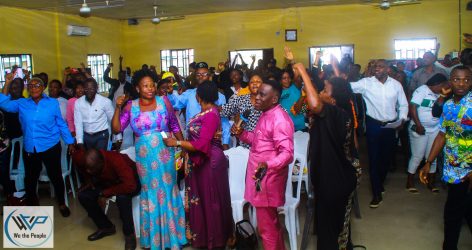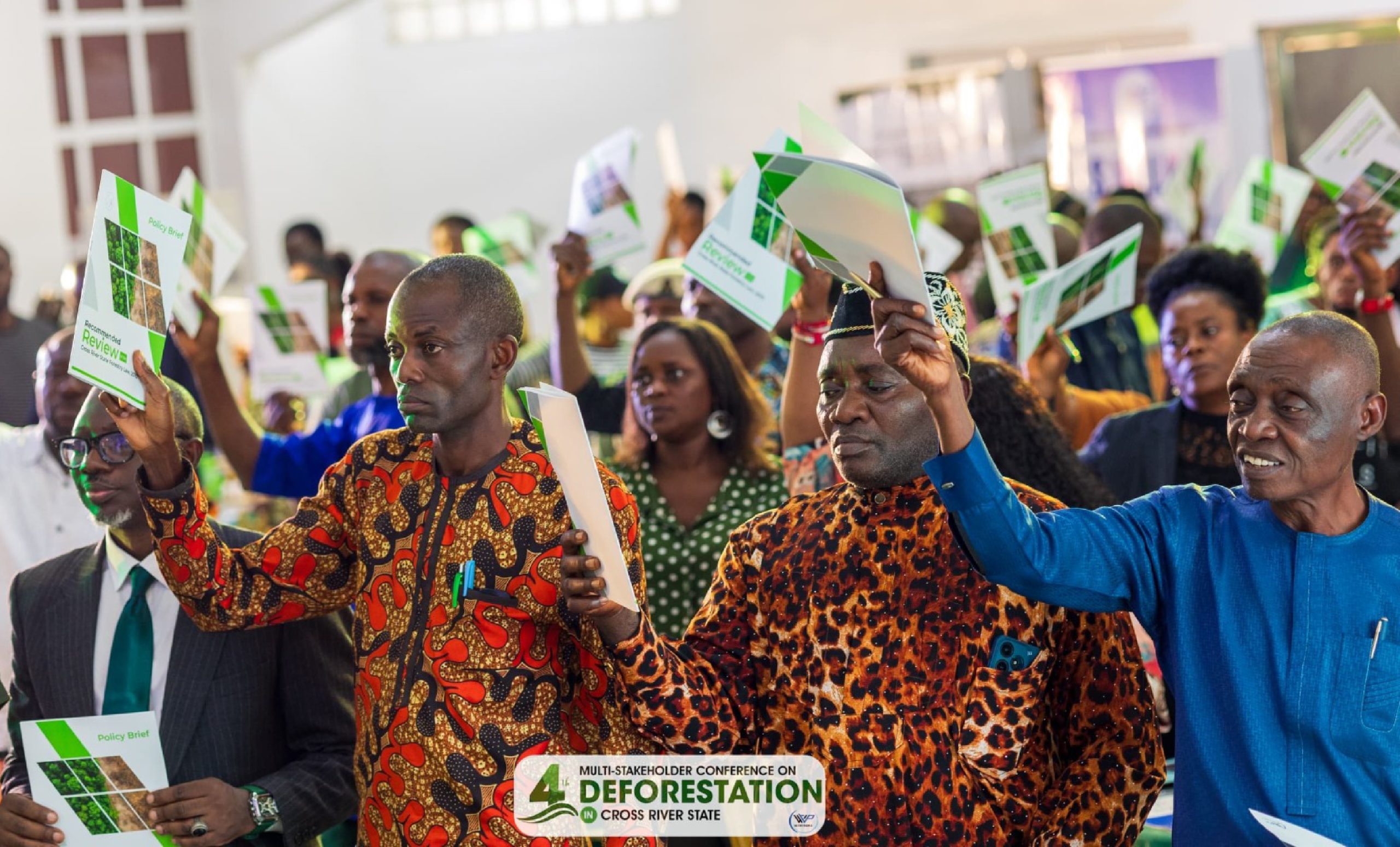
On 23 July 2026, We the People, in partnership with environmental and community organizations, convened the 4th Multi-Stakeholder Conference on Deforestation in Calabar, Cross River State, under the theme “Forest, People and Policy: Shifting Power and Strategies for Combating Deforestation.” The conference brought together more than 150 participants, including public officials, communities, environmentalists, civil society organizations, and the media to address the growing threats facing Cross River’s forests. As one of Nigeria’s last remaining tropical rainforest strongholds, Cross River continues to experience increasing pressure from illegal mining, unsustainable logging, weak forest governance, and the escalating impacts of climate change. Against this backdrop, the conference provided an important platform for dialogue, knowledge sharing, and collective action aimed at protecting forests while advancing the rights and livelihoods of forest-dependent communities.
Opening the conference, Ken Henshaw, Director of We the People, delivered a keynote presentation titled Cross River at the Crossroads: Between Vanishing Forests, Mining and Climate Change. He highlighted the alarming pace of forest destruction and warned that continued environmental degradation threatens biodiversity, weakens climate resilience, and undermines the livelihoods of indigenous and forest-dependent communities. He emphasized that reversing these trends requires coordinated action involving government institutions, civil society, local communities, and development partners working towards a shared vision of sustainable forest governance
In his follow up presentation, Dr. Martins Egot of PADDIC-Africa presented civil society recommendations for the review of the Cross River State Forestry Law 2010, to bring it in tanderm with current climate change and forest protection realities.
Redzie Jugo, Esq., lawyer and environmental rights defender, led a conversation on the growing links between mining, deforestation, and insecurity, drawing lessons from Zamfara State. He explained how poorly regulated extractive activities have fueled violence, weakened governance, and left host communities to bear the environmental and social costs while receiving little in return. He emphasized that communities are not obstacles to development; rather, they are the first and strongest line of defense when they are recognized as legitimate custodians of their forests and given meaningful authority to participate in decision-making.
Daryl Bosu from A- Rusha Ghana, led a discussion that examined Ghana’s experience in addressing illegal mining and forest loss. The presentation demonstrated that lasting progress depends not only on stronger laws but also on political will, effective institutions, meaningful community participation, and consistent enforcement. These lessons resonated strongly with participants, who reflected on how similar approaches could be adapted within the Cross River context. He encouraged stakeholders to move beyond reactive enforcement by investing in community-led forest governance, stronger monitoring systems, and transparent institutions capable of holding powerful actors accountable. He stressed that protecting forests is ultimately a matter of national interest, as healthy ecosystems underpin food security, water resources, climate resilience, and long-term economic prosperity.
Participants explored practical solutions to the intertwined challenges of deforestation, illegal mining, environmental insecurity, and weak policy implementation. Discussions examined the urgent need to reform Cross River State’s forestry laws to better respond to emerging threats while strengthening institutional capacity for enforcement and sustainable forest management. Speakers also reflected on lessons from other regions where poorly regulated mining activities have contributed to environmental degradation, and social conflict among others, underscoring the importance of acting before similar patterns become further entrenched in Cross River State.
The conference concluded with a panel discussion that brought together representatives of forest host communities, civil society organizations, and legal practitioners. Panelists emphasized that combating deforestation requires more than government action alone. Strong partnerships with communities, improved implementation of environmental laws, enhanced accountability, and meaningful community participation in decision-making remain central to protecting forests and ensuring environmental justice.
The conference reaffirmed a shared commitment among stakeholders to pursue comprehensive forestry law reforms, strengthen oversight of mining activities, improve protection for forest ecosystems, and ensure that communities are recognized as essential partners in forest governance. More importantly, it reinforced the understanding that safeguarding Cross River’s forests is not only an environmental imperative but also a matter of protecting livelihoods, human rights, and the future of sustainable development in Nigeria.
For We the People, the conference represents another step in building a broad coalition committed to shifting power towards communities, strengthening environmental governance, and advancing policies that place both forests and people at the heart of sustainable development.