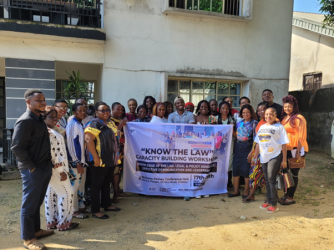
On Thursday, September 17, 2026, We the People partnered with PADIC-Africa and Biodiversity Rescue Club for a webinar themed, “Cross River State Forestry Law: Policy Gaps and Reform Priorities.” For decades, Cross River State held the largest and most pristine contiguous rainforest belt in Nigeria and across West Africa. However, driven by unprecedented logging, expanding agricultural plantations, mining, wildlife poaching, and timber exports, up to 60% of the original forest cover has been lost. Between 2007 and 2014 alone, the state lost approximately 30% of its forest cover. Despite a 2008 moratorium and the passage of the Cross River State Forestry Law in 2010, illegal forest extraction has escalated. The webinar brought together communities, environmental justice advocates, legal practitioners, and conservation specialists to interrogate a fundamental question: How capable and proactive is the 16-year-old 2010 Forestry Law in addressing contemporary deforestation, climate change, and forest crime in 2026?
Ken Henshaw, Executive Director of We the People, set the foundation for the conversation by highlighting the scale of forest loss across Cross River State. He noted that rather than halting deforestation, the 2008 moratorium inadvertently triggered massive forest loss, while the subsequent 2010 Forestry Law has grown outdated and incapable of serving as a proactive safeguard. Henshaw raised sharp questions regarding the strength of current deterrent measures, the complete lack of climate change integration, and the absence of mandates for reforestation. In fact, under the 2010 law, civil society organizations seeking to undertake reforestation must pay fees to the Forestry Commission—a counterproductive action to ecological restoration. He introduced a joint civil society policy proposal—developed over six months by We the People, PADIC Africa, NCF, and partner organizations—designed to overhaul the state’s forestry legal framework to reflect contemporary realities.
Dr. Martins Egot, Executive Director of PADIC Africa, characterized the current state of Cross River forests as total lawlessness and “forest banditry,” where timber resources are being depleted with reckless abandon. Egot argued that the core failure lies within the structural weaknesses of the 2010 Law, which treats the forest purely as a timber-cutting business rather than an ecological asset. He stressed that the existing law lacks provisions for carbon credit frameworks, ecosystem services, traceability, gender inclusion, and community-led protection. Recalling how indigenous community action successfully halted logging encroachments in the Ekuri forests, Egot asserted that a complete legal review is mandatory to realign state governance with global environmental standards.
Emmanuel Owan, Cross River State Coordinator for the Nigerian Conservation Foundation (NCF), centered his presentation on the dual role of forests as carbon sinks and sources of carbon when cut, emphasizing the need to build community-level incentives to stop forest degradation. Owan highlighted that traditional conservation models fail when they treat local populations as mere “beneficiaries” receiving handouts, rather than equal “partners” who share in management responsibilities and outcomes. He shared NCF’s practical framework of organizing community cooperatives, providing agricultural value-addition schemes (such as local processing of plantain and banana flour linked with NAFDAC registrations), and creating sustainable benefit-sharing mechanisms that reduce community reliance on timber extraction.
Augustine Vicker Uka, project officer at We the People and legal practitioner, examined the law from a comparative jurisprudential perspective, focusing on the total collapse of legal deterrence. Uka argued that a living law must evolve alongside the economic growth and social consciousness of its people. He pointed out that current fines under Sections 71, 83, 85, and 88—ranging from just ₦100,000 to ₦200,000 for severe infractions like poaching endangered species or impounding illegal logging gear—act as an incentive for crime rather than a deterrent, given that a single tree stump can yield over ₦1,000,000. Drawing lessons from international precedents Indonesia, United States, and Brazil, Uka urged the adoption of corporate vicarious liability for entities purchasing illegal timber and recommended directing a percentage of recovered fines into a Community Forest Protection Fund.
Contributions during the open dialogue reinforced the urgency of political mobilization. Edem Edem, Executive Director of Green Code, emphasized that civil society must fast-track legislative engagement before upcoming political campaigns distract lawmakers. Ben Usang urged advocates to put the government on the spot and demand a conservator-general within a restructured, conflict-free Forestry Commission.
The webinar ended with a clear call for updated legal sanctions, institutionalizing community participation, establishing conflict-of-interest rules, and integrating climate mitigation and mandatory reforestation frameworks into state law.