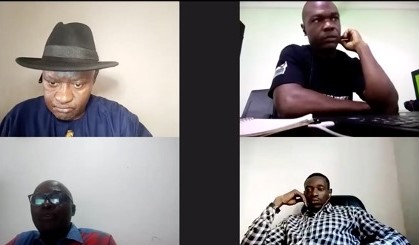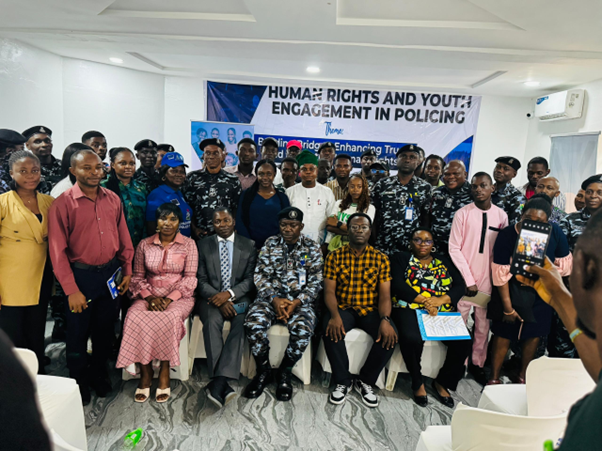
On Friday, August 22, 2025, We the People convened a one-day workshop on human rights and youth engagement in policing, under the theme “Building Bridges, Enhancing Trust and Promoting Human Rights”. The workshop, held in Calabar, Cross River State, brought together over 30 police officers and 60 young people across the state as part of the #IncludeNaija Project supported by the European Union. Nigeria’s youth, the country’s largest population demography, have long faced harassment, profiling, and abuse at the hands of security agents, in the country, limiting their ability to fully participate in policy and governance. This strained relationship has often pitched both groups against each other, and let to tensions.
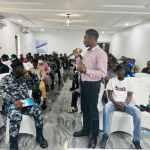
The workshop aimed at understanding the sources of the frosty relationship, especially the challenges which officers of the police face, as well as strategies to build collaboration and engagement.
In his opening speech, Augustine Vicker Uka, Program Officer at We the People, the workshop aimed to “build bridges, enhance trust, and provide tools with which security officers and youths can address rights abuses as joint stakeholders in creating safe spaces for citizens”
Attah Ochinke, human rights lawyer and former Attorney General and Commissioner for Justice in Cross River State, in his keynote challenged the “colonial mindset” still shaping policing in Nigeria. He stressed that democracy cannot thrive without human rights protection: “Periodic elections are not a guarantee for democracy; the observance of human rights is. Without human rights, there is no civilization” he said. He urged youth, despite being the most vulnerable group in terms of rights abuses, to collaborate with police in promoting efficient and rights-respecting law enforcement.
The Assistant Commissioner of Police for Cross River State, Adewalehinmi Joshua O. who represented the state Commissioner of Police, encouraged young people to demand their rights constructively. According to ACP Adewalehinmi, “in the game of nation-building, the police and the youth are teammates who must fight their common enemies. Confrontation should be on the table, not on the streets.”
James Ibor, lawyer and Executive Director of Basic Rights Council, decried poor funding as a major driver of police abuses. He noted that without adequate financial resources, officers are often forced to work under inhumane conditions, rely on informal levies from citizens, or resort to extortion as a means of survival. According to him, “a police system that is underfunded is almost destined to abuse the very citizens it is meant to protect.”
Executive Director of We the People, Ken Henshaw, while thanking the European Union for its support, urged youth leaders to use their platforms to hold public officials accountable rather than settle for token recognition. He emphasized that sustainable change requires citizens, especially young people, to be vigilant in demanding reforms and resisting attempts to silence their voices.
The workshop ended on a hopeful note. Both youth leaders and police officers openly acknowledged past tensions but agreed that a new chapter was possible—one built on mutual respect, trust, and shared responsibility. They resolved to work together to address human rights abuses, strengthen community-police relationships, and foster peace and security across Cross River State. This collective commitment, stemming from dialogue and mutual understanding, signals a promising step toward accountability in law enforcement, the protection of citizens’ rights, and the strengthening of Nigeria’s democracy.