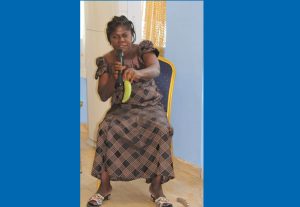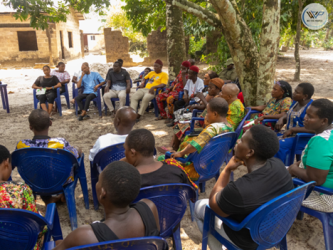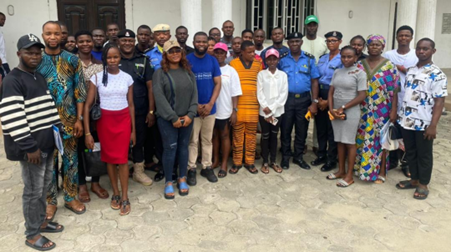
On Thursday, March 26th, 2026, We the People’s #IncludeNaija project, facilitated a Police-Youth Roundtable at the Rumuolumeni Town Hall, Port Harcourt, themed: “Bridging the Gap: Strengthening Police-Youth Synergy for Inclusive Security and Human Rights Protection.”
Historically, the intersection of the Nigerian Police and the youth demographic has been tainted and bedevilled by systemic friction. This legacy of distrust, rooted in profiling and state-sanctioned exclusion, forms the backdrop for the European Union-funded #IncludeNaija project, which seeks to dismantle these barriers and foster a partnership based on mutual accountability and respect.
The session, attended by Mrs. Ngozi Oha, Divisional Police Officer in charge of Rumuolumeni, (represented by Mr. Amakiri Justice), Student Union leaders from Ignatius Ajuru University of Education (IAUE), community youth leaders and young civil society actors, served as a forum for discussion and expression of shared concerns around relations between the police and youths.
The grievances voiced by the youth were poignant and varied. Complaining of systemic profiling, Mr. Joseph Ndifreke observed that “in this country, it is a crime for a youth to look rich or be rich. The rich among us are usually victimized and unreasonably suspected”
Miss Gideon Helen Gideon, a student of Ignatius Ajuru University of Education decried instances of extortion and physical assault, detailing how officers “unlawfully and forcefully accessed her bank apps, gallery, and other private mobile applications.” She cited privacy violation as a recurring menace.
Mr. Felix Chinda, the Youth Leader of Rumuolumeni community and Miss Lebie Justina recounted experiences of the Police being used as instruments of political oppression and the disturbing trend of making “arrests in lieu” of actual suspects.
In a candid rebuttal, Mr. Amakiri Justice, supported by Officers John Etim and Isaac Wilson, attributed institutional shortfalls to a weak legal framework and societal reflections. He noted, “the face does not see itself except from the reflection of a mirror. The concerns you have shared of the Police are noted, but only occupational interest has made them different from you.” He further emphasized that “the Police is a product of the society; we are what the society creates.”
Addressing the limitations of the force, he further stated that “the Police is a reflection of the Law. They are empowered by law. If the Law that empowers the Police is weak, the institutions that a weak legal regime creates will also be weak.” He urged the youth to seek accountability “constructively,” via official channels rather than street confrontations.
Leading the “Street Law” segment of the Roundtable, Augustine Vicker Uka esq, WTP Project Officer, provided constitutional clarity on the limits of “reasonable suspicion.” He asserted that “dressing should be de-emphasized as a ground for suspicion. Nigerian youths should not be forced to dress poorly in order to avoid police stigmatization. Being rich and possessing mobile gadgets in a world ruled by technology should not be criminalized.”
The engagement concluded with a bilateral commitment to reclaim eroded trust and transform both law enforcement and the youth population into champions of human rights.