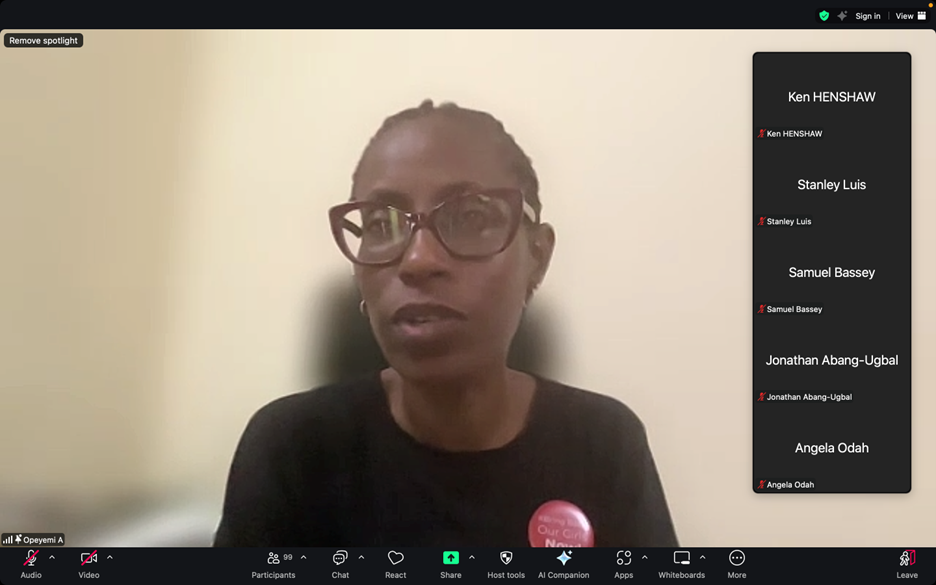
On October 20, 2025, We the People convened a virtual conference with the title “#EndSARS 5 Years After: Remembering, Resisting, and Reclaiming Justice.” The Conference which was organized as part of the #IncludeNaija Project supported by the European Union, brought together over 100 participants including young people, activists, lawyers, victims of law enforcement abuses and civil society organizations, to reflect on the legacy of the historic #EndSARS protests of 2020, assess the wins and setbacks, and renew collective demands for justice and accountability. The protests were ignited by years of atrocities, abuses, extortion, and extrajudicial killings by the Police Force generally, but also by the extreme ruthlessness of the Special Anti-Robbery Squad (SARS) #EndSARS quickly became a national movement for justice, dignity, accountability and respect for the right of its citizens.
Opening the session, Opeyemi Ademolokun, Executive Director of Enough is Enough Nigeria and one of the pioneers of the ‘5For5’ demands of the protests, spoke on the struggles and prospects that defined the #EndSARS movement. She lamented the government’s lack of political will to address the protesters’ demands five years later. Opeyemi noted that despite several state judicial panels of inquiry, almost none of their findings and recommendations have been implemented — with only Lagos State’s panel report made public. Responding to claims that protests risk being “hijacked,” Opeyemi stressed that it is the duty of the state to protect peaceful protesters and uphold its constitutional responsibility to ensure the security and welfare of citizens, rather than using such excuses to shrink democratic space and violate fundamental rights.
Jonathan Ugbal, activist and a key figure in the #EndSARS protests in Cross River State, spoke passionately about the importance of memory, accountability, and truth-telling in sustaining any people’s movement. He stressed that the story of #EndSARS must not be erased or rewritten to suit the state’s narrative, as collective memory is a powerful tool of resistance. Jonathan argued that those who stood against the demands and rights of Nigerian citizens during the protests, including individuals who ordered, enabled, or justified violence and repression must not be rewarded with appointments or elective positions. According to him, such actions not only embolden impunity but also dishonor the lives lost and the courage of young Nigerians who rose to demand change.
Speaking further, Enefaa Georgewill, Convener of the Rivers State Civil Society Organization (RIVSCO), highlighted the interconnectedness of injustice and systemic abuse in Nigeria. He noted that these challenges are deep-rooted and multifaceted, cutting across police brutality, environmental degradation, economic inequality, and political exclusion. According to him, these issues cannot be tackled in isolation, as they are symptoms of a larger governance failure and structural rot. Enefaa emphasized that the #EndSARS movement exposed a broken system that consistently sidelines citizens while protecting impunity. He called on young people to build stronger alliances, develop long-term strategies beyond protest moments, and push for sustained systemic reforms despite the intimidation, arrests, and smear campaigns experienced during and after the protests.
The discussions were engaging and reflective, rekindling the collective memory of a movement that inspired a generation. Participants resolved to intensify efforts toward demanding accountability, preserve the history and spirit of #EndSARS, and continue organizing to resist the shrinking of the civic space in Nigeria.