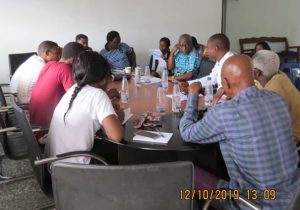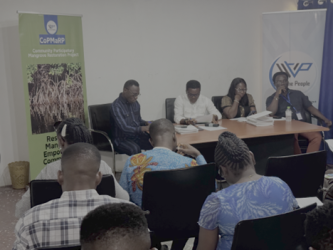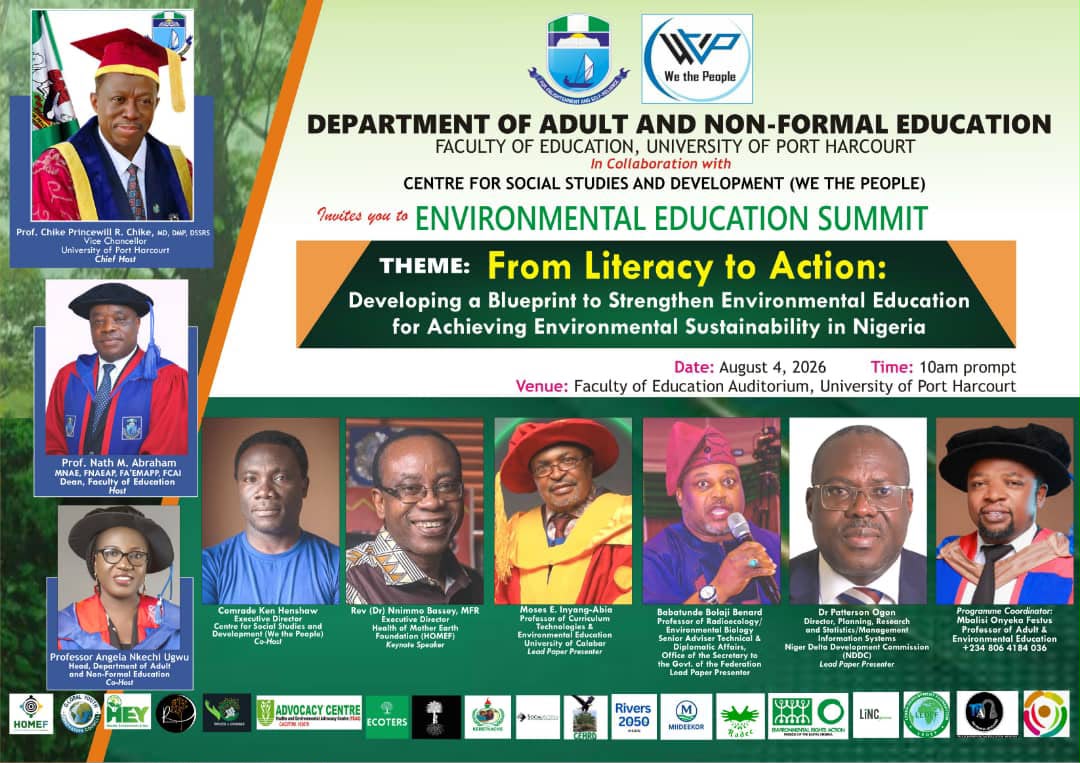
On August 4th 2026, We the People in partnership with the Department of Adult and Non-Formal Education, University of Port Harcourt, and Social Action, held an environmental education summit themed “From Literacy to Action: Developing a Blueprint to Strengthen Environmental Education for Achieving Environmental Sustainability in Nigeria.” The summit brought together academics, environmental experts, civil society organizations, development practitioners, students, and members of the public to examine practical approaches to strengthening environmental education and translating environmental knowledge into meaningful action across Nigeria.
Speaking during the summit, Dr. Prince Edegbuo, Programs Manager at Social Action, underscored the fundamental importance of the environment to human survival and wellbeing. He noted that the environment provides essential resources that sustain life and called on individuals, government institutions, civil society organizations, educational institutions, and other stakeholders to recognize their shared responsibility for protecting it. He emphasized that environmental protection requires collective action and cannot be left to governments or environmental organizations alone.
The summit also examined humanity’s responsibility as stewards of the earth. Prof Babatunde Bernadan, an Environmental Scientist, Radioecologist and Academic, drew on religious references to emphasize the obligation of human beings to care for the earth. He observed that humanity has fallen short of this responsibility, contributing significantly to environmental degradation. He further highlighted the scale of mangrove loss in the Niger Delta, noting that available studies indicate that the region has lost between 40 and 45 percent of its mangrove forests, with significant consequences for ecosystems, livelihoods, and communities that depend on them.
A key outcome of the summit was the recognition that environmental education must go beyond the classroom. Participants called for environmental knowledge to reach farmers, fishers, rural communities, policymakers, and the wider public, ensuring that environmental considerations become part of everyday decisions and practices. Participants also recommended the establishment and strengthening of environmental clubs and societies in schools as a way of nurturing environmental consciousness among young people. Another important recommendation was the need to integrate environmental education across disciplines rather than treating it as the exclusive responsibility of environmental science or related fields.
In his closing remarks, Prof. Eneji Chris Valentine, an Environmental Educator, Rural Development Expert, Academic Administrator, and Associate Professor in the Department of Environmental Education at the University of Calabar, called for stronger community-based research and environmental awareness initiatives. He emphasized that lasting environmental change requires sustained engagement with communities, meaningful public participation, and continued collaboration among relevant stakeholders.
We the People recognizes that knowledge is most powerful when communities can use it to understand, defend, and shape decisions affecting their environment and livelihoods. We the People remains committed to advancing environmental justice, strengthening community participation, and supporting initiatives that empower people to protect their environment and demand accountability for environmental harm across the Niger Delta and beyond.