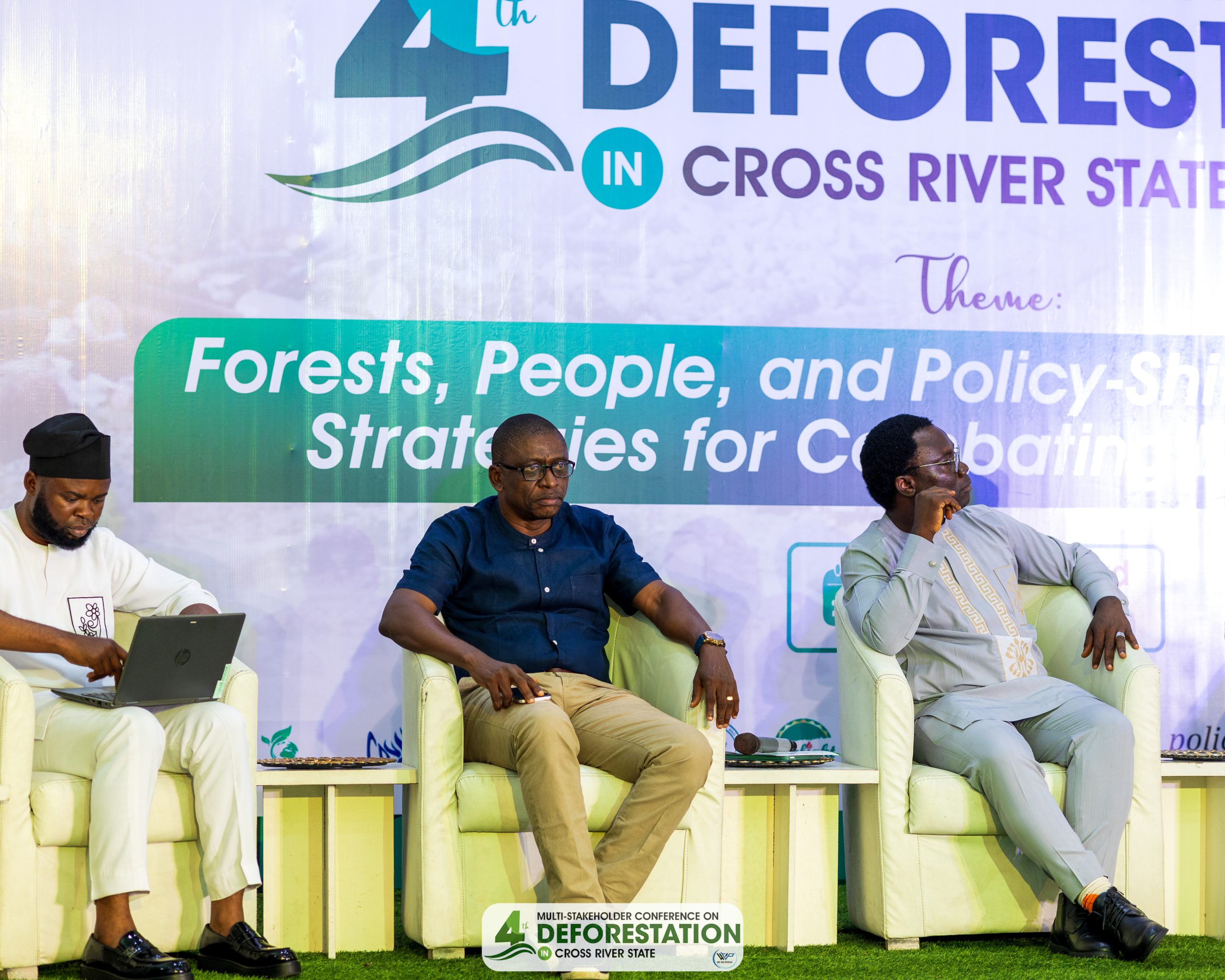
COMMUNIQUÉ ISSUED AT THE END OF THE 4TH MULTI-STAKEHOLDER CONFERENCE ON DEFORESTATION IN CROSS RIVER STATE ON THURSDAY, 23 JULY 2026
Theme: Forests, People, and Policy: Shifting Power and Strategies for Combating Deforestation
The 4th Multi-Stakeholder Conference on Deforestation in Cross River State, convened by We the People and its partners, was held on Thursday, 23 July 2026, in Calabar under the theme “Forests, People, and Policy: Shifting Power and Strategies for Combating Deforestation.” The Conference brought together more than 150 participants comprising representatives of state government institutions, traditional rulers, forest-dependent communities, civil society organizations, conservationist, academics, legal experts, and journalists, to collectively examine the worsening crisis of deforestation in Cross River State and develop practical pathways towards protecting the state’s remaining forests.
The Conference reaffirmed that Cross River State’s forests constitute one of Nigeria’s most valuable ecological assets and remain central to biodiversity conservation, climate resilience, water security, cultural heritage, and the livelihoods of thousands of forest-dependent communities. Participants expressed grave concern that despite decades of interventions, the destruction of the state’s forests continues unabated, threatening not only the environment but also the social and economic wellbeing of present and future generations.
The Conference observed that in 2008, the Cross River State Government instituted a moratorium on logging and commercial forest activities in response to the alarming rate of deforestation. While the objective of protecting the state’s forests was commendable, the Conference noted that the policy failed to achieve its intended outcomes. Evidence presented showed that despite the ban, approximately 1,070 square kilometres of forest were lost between 2007 and 2014. Although comprehensive official data for the period between 2014 and 2026 remain limited, satellite imagery, field observations and community reports all indicate that forest loss accelerated significantly during those years.
The Conference further observed that the lifting of the moratorium in 2023 acknowledged the limitations of the forest ban and the shortcomings of the United Nations-supported Reducing Emissions from Deforestation and Forest Degradation (REDD+) framework upon which much of the policy had been based. However, participants noted that despite the introduction of new forest management strategies, deforestation continues at an alarming rate and Cross River State can no longer credibly claim to possess West Africa’s largest remaining rainforest.
The Conference expressed deep concern that the character of deforestation has fundamentally changed. Illegal logging has evolved into a highly organized and transnational enterprise involving foreign interests operating in collaboration with local actors. Valuable timber species continue to be extracted illegally and exported beyond Nigeria’s borders while enforcement institutions appear either unable or unwilling to halt the destruction. The Conference lamented that the communities that have protected these forests for generations are increasingly dispossessed of their lands, deprived of their livelihoods, and excluded from decisions affecting the future of their forests.
The Conference further noted with alarm the rapid expansion of mining activities within and around forest reserves. Participants observed that mining has emerged as a major driver of deforestation, biodiversity loss, pollution of rivers, destruction of farmlands, displacement of communities, and increasing insecurity. Drawing lessons from the experiences of Ghana and conflict-affected regions in Nigeria’s Middle Belt, participants recognized that weak governance of natural resources often creates conditions for organized criminality, violent conflict, and social instability.
The Conference also reflected critically on the use of forest bans as instruments of conservation. Participants observed that while such measures are often presented as environmental protection policies, their implementation has frequently imposed disproportionate burdens on forest-dependent communities while politically connected individuals, commercial interests, and powerful actors continue to exploit forest resources with relative impunity. Genuine forest conservation, the Conference concluded, cannot be achieved through exclusionary policies that marginalize the very communities whose survival depends upon healthy and standing forests.
The Conference reaffirmed that forest-dependent communities are not obstacles to conservation but indispensable partners in protecting biodiversity. It recognized that generations of indigenous knowledge and customary management systems have sustained Cross River’s forests long before the emergence of contemporary conservation programs. Participants therefore stressed that lasting forest protection requires shifting power towards communities by recognizing their rights, strengthening community institutions, and ensuring their meaningful participation in forest governance.
Observations
Following extensive deliberations, the conference observed that:
- Deforestation has reached crisis proportions across Cross River State’s National Park, State Forest Reserves, and Community Forests, threatening biodiversity, climate resilience, and community survival.
- Organized illegal logging, illegal mining, agricultural expansion, plantation development, weak governance, corruption, and inadequate law enforcement now collectively drive forest destruction across the state.
- Foreign interests, working alongside local collaborators and protected by weak institutional oversight, continue to profit from the illegal extraction and international export of valuable timber resources.
- Mining operations within forest landscapes have become an emerging and significant driver of environmental degradation, forced migration, livelihood losses, insecurity, and social conflict, with reports of illegal mining activities occurring even within protected areas.
- The uncontrolled exploitation of forest resources continues to deprive host communities of their ancestral lands, cultural heritage, traditional livelihoods, and ecological security.
- Government agencies responsible for forest governance remain inadequately funded, poorly staffed, and insufficiently equipped to effectively enforce existing laws and protect remaining forests.
- Community exclusion from forest governance has significantly weakened conservation efforts, undermined trust, and diminished opportunities for collaborative forest management.
- The expansion of cocoa and oil palm plantations continues to accelerate forest loss, despite the inability of such plantations to replicate the ecological functions and biodiversity values of natural forests.
- The Cross River State Forestry Law is no longer adequate to address the contemporary realities of forest governance, biodiversity protection, climate change, organized environmental crime and community rights.
Resolutions and Recommendations
Accordingly, the Conference resolved as follows:
- That the Government of Cross River State should immediately commence a comprehensive review of the Cross River State Forestry Law, drawing upon the published recommendations developed by civil society organizations and other stakeholders to establish a modern legal framework for forest governance.
- That mining activities should be prohibited in all protected forests and conservation areas across Cross River State, while existing reports of illegal mining within protected areas should be thoroughly investigated and prosecuted in accordance with Nigerian law.
- That all mining licenses issued within Cross River State should be publicly disclosed in the interest of transparency, accountability and informed public participation in natural resource governance.
- That the doctrine of “overriding public interest” should not be invoked to justify forest exploitation without the free, prior and informed participation of affected communities. Comprehensive Environmental Impact Assessments must be conducted transparently and community concerns fully incorporated into all decision-making processes.
- That appropriate legal action should be pursued to obtain judicial clarification on the meaning and limits of the concept of “overriding public interest” as it relates to forest governance, land rights and natural resource management.
- That community-led forest governance should become the foundation of forest conservation in Cross River State, with local communities empowered to monitor forests, prevent illegal activities and participate directly in decision-making processes.
- That Community Forest Reserves owned, governed and protected by local communities should be established and legally recognized as an important mechanism for biodiversity conservation and the protection of community rights.
- That government and development partners should invest in sustainable livelihood alternatives capable of reducing dependence on destructive forest exploitation while improving economic opportunities within forest communities.
- That a permanent coalition of civil society organizations, forest host communities, legal practitioners, researchers and conservation organizations should be established to coordinate advocacy, strategic litigation, policy engagement and public accountability on forest governance.
- That forest and mining frontline communities in Cross River state should collaborate and networks with their counterparts in other parts of the country and the world to exchange learning and forge united fronts to enforce the protection of their rights.
Conclusion
The Conference concluded that the future of Cross River State’s forests will not be secured through bans alone, nor through policies developed without the participation of the people who have protected these forests for generations. The continuing destruction of the state’s forests represents a profound governance failure that demands bold political leadership, stronger institutions, transparent natural resource management and the recognition of communities as equal partners in conservation.
The Conference further comments that Cross River’s forests are not merely timber resources. They are living ecosystems, cultural landscapes, climate buffers, sources of livelihoods, and an irreplaceable indigenous and national heritage. Their protection is both an environmental imperative and a matter of justice. The Conference therefore calls upon the Federal Government, the Government of Cross River State, the National Assembly, the Cross River State House of Assembly, conservation organizations, and all citizens to act with urgency and resolve.
Issued this 23rd day of July, 2026, in Calabar, Cross River State, an d en dosed by the following organizations:
- We the People
- PADIC-Africa).
- Cross River State Civil Society Network.
- African Dignity Foundation.
- Peace Point Development Foundation.
- Biakwan Light Green Initiative.
- Uyo Iban Amplifiers Initiative.
- Nigerian Conservation Foundation, Cross River.
- Integrated Mangrove Watch.
- Citizens’ Solution Network.
- Know Your Rights Initiative.
- Cross River Forest Host Communities Network.
- Light Bearer’s Organisation
- Conservator of Park (CP), Cross River State
- Women Empowerment and Enlightenment Foundation.
- Onyx Community and Development Foundation.
- Association of Environmental Lawyers, Nigeria
- Policy Alert
- Green Planet Initiative International