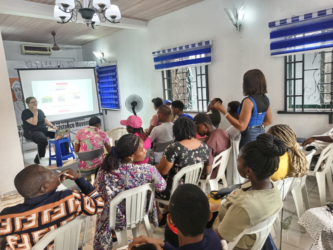
As part of its ongoing anti-deforestation campaign, We the People convened a two-day community dialogue in Oban, Akamkpa Local Government Area, on the 5th and 6th of May, 2026, bringing together traditional leaders, youth, and forest-dependent communities to strengthen collective action against illegal logging and promote community-led forest conservation.
The dialogue, held under the Cross River State Forest Host Communities Network (CRSFHCN), built on earlier engagements in Okuni and Akaraba communities in Ikom Local Government Area, where communities developed strategies to address the growing threat of deforestation. The Oban meeting sought to expand the Network into Ejagham-East communities while reinforcing local ownership of forest protection efforts.
Activities began with a courtesy visit to the traditional ruler of Oban Clan, Ntufam Stephen Edet Mbey, and his council to formally introduce the campaign and seek their support for establishing the Forest Host Communities Network in the area. Participants also visited degraded forest sites to witness firsthand the extent of environmental destruction caused by years of unsustainable logging, reinforcing the urgency of collective action to protect the remaining forest.
The main dialogue, held at the Ejagham-East Headquarters, brought together representatives from several forest communities across Akamkpa Constituency. Discussions focused on the realities facing forest-dependent communities and practical approaches to safeguarding their forests.
Participants identified illegal logging, external encroachment into community forests, and weak local accountability as major drivers of deforestation. Community members stressed that forest protection requires stronger collaboration between traditional institutions, youth, women, and community leaders, as well as greater resistance to illegal logging activities.
A major highlight of the dialogue was a presentation by community leader Ntufam Felix Ntambu, who outlined the three guiding principles of the Forest Host Communities Network: Protect, Restore, and Resist.
He explained that protecting the forest is a shared responsibility, warning that continued inaction could leave future generations without forests. On restoration, he emphasized the importance of preserving existing forests, noting that mature forests cannot simply be replaced through tree planting.
Speaking on resistance, he urged communities to reject illegal logging and other destructive activities that continue to enrich a few while leaving host communities with degraded ecosystems, drying streams, rising temperatures, and declining livelihoods. He also highlighted the critical role forests play in preventing erosion, regulating climate, preserving biodiversity, and sustaining local livelihoods.
We the People’s Project Lead for the Anti-Deforestation Campaign, Ukeme Ekong, linked forest loss to the growing impacts of climate change across Cross River State. Drawing on experiences from Ikot Effanga Mkpa, he described how widespread deforestation has contributed to severe erosion, displacement of families, and the destruction of homes and farmlands.
He explained that the Cross River State Forest Host Communities Network is designed to strengthen grassroots organising, amplify community voices, and build a coordinated movement capable of defending community forests and promoting forest governance.
The proposal to establish the Forest Host Communities Network in Ejagham-East received overwhelming support from participants, reflecting strong community commitment to protecting their forests and securing their environmental future.
Through the Cross River State Forest Host Communities Network, forest-dependent communities are building a united grassroots movement committed to protecting forests, strengthening climate resilience, and advancing environmental justice across Cross River State.