Concept Note:
In 2008, arising from an environmental summit, the Cross River state government instituted a
ban on all forest activities, specifically targeting loggers which it considered the key drivers
of deforestation at the time. For the government, this action was necessitated by the need to
protect the most critical asset of Cross River state which is its vast forests and the wildlife it
shelters.
The Cross River forests were considered the richest cover in the whole of West Africa right
up to the 20 th Century. A massive share of the forest cover left in Nigeria is located in the
state. As at 1990, it was estimated that 50% of Nigeria’s remaining forest was located in
Cross River, spanning through tropical rainforests and large spreads of mangrove swamps in
its southern parts. As at 1991, the total forest cover located in Cross River stood at 7,920
Km2, roughly covering about 34.3% of the state's overall surface area. By 2008, the forest
cover underwent considerable decline and dropped to about 6,102 Km2 and occupying
28.68% of the state's landmass. Between 1991 and 2001, the state lost 1,514 Km2 of forest
amounting to 12% of its forest cover. Another 1,307 Km2 of forest was lost in the 8-year
period between 2000 and 2008, indicating a 17.64% decline in the state’s forest. Available
records indicate that each year, the rate of deforestation intensifies, signifying a
corresponding increase in the number of factors that drive forest loss which includes illegal
logging, agriculture, urbanization, amongst others. Other data indicates that between 2000
and 2007, the forest loss was about 390 Km2. Between 2007 and 2014, the rate increased
sharply to 1,070Km2 in 7 years. At the moment, the categorization of Cross River state as the
home of West Africa’s largest forests is highly in doubt. The forests have come under severe
attacks by several actors including the state government, plantation companies and illegal
loggers.
Despite the moratorium on forest activities placed by the state government 14 years earlier,
the spate of deforestation has rather intensified. At the moment, logging activities have taken
more alarming and sinister dimensions in the state. In several communities, loggers and
timber dealers establish their trading posts close to the forests, and form trade unions to
regulate the business. Logs are openly processed into various sizes, loaded onto trucks and
transported to destinations within and outside the state fairly easily. Transportation by road
requires the regular compromising of law enforcement officials including agencies tasked
with checking illegal forest dealings. On the rare occasions where seizures of timber take
place, it is often as a result of disagreements over rates of ‘settlement’.
To facilitate the theft of forest resources, the state has seen the emergence of armed non-state
actors often called ‘Crossers’ who take responsibility for arranging consignments of timber
from the forest, and conveying them to designated destinations outside the state. Their rank
consists of thugs and militants armed with illegal firearms, deployed to intimidate, terrorize
and maim forest protection agents and community vigilante groups that they perceive as
threats to their operations. On several occasions, ‘Crossers’ are known to have attacked community members, volunteer groups and task force members who prevent illegal extraction and transportation of timber products.
The illicit trade in timber has expanded to include foreign (Chinese) interests as well as
international dimensions. Exotic species of wood are illegally extracted from the forests and
exported overseas. While the forests undergo systematic dissipation, communities who
traditionally own these forests and have protected it for generations are not only losing their
livelihoods, but also their heritage. With the loss of forest cover, the impacts of climate
change are becoming more threatening and dire. Other drivers of deforestation include salvage logging by commercial scale agro-companies and private plantations, expansion of commercial agriculture and government infrastructural projects.
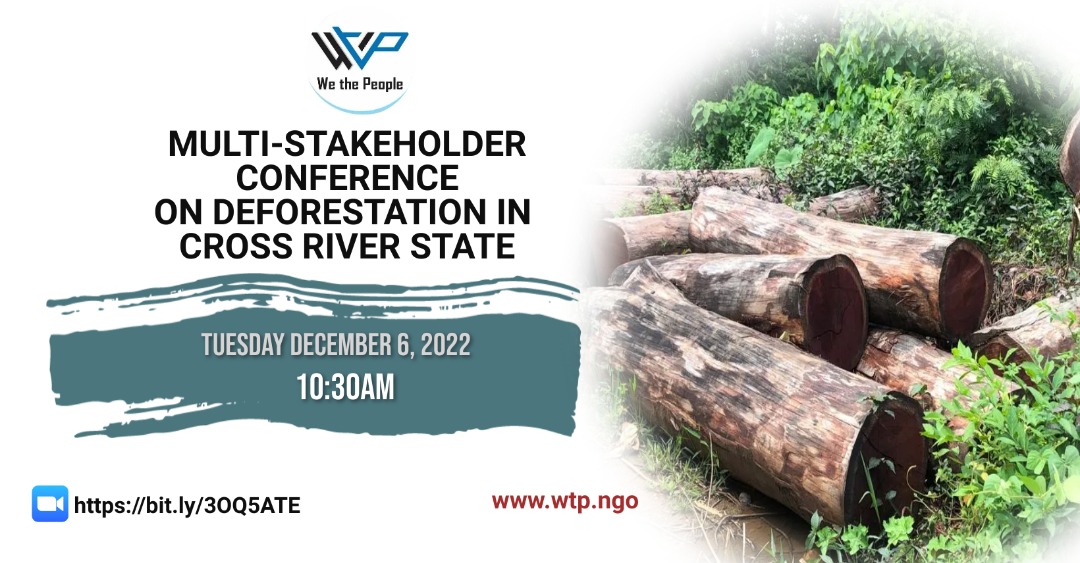
Faced with these realities and the need to have a comprehensive strategy and response to the
ongoing deforestation, We the People and partners are organizing a Multi-Stakeholder
Conference on Deforestation in Cross River state.
The Conference
This Multi Stakeholder Conference on Deforestation is broadly aimed at highlighting the
escalating threat of deforestation, as well as the gaps and challenges associated with existing
government responses. The Conference will explore frameworks and policy options for
addressing deforestation, and produce a draft policy alternative. It is expected that the
Conference will expand the awareness of community members and other civil society actors
on deforestation, and increase their agency in that regard.
This Conference will bring together experts from the academia, civil society, the government
and communities to share experiences while brainstorming on policy alternatives for
protecting the forests and addressing deforestation.
Details
Date: 6 th December, 2022
Venue: The Kolanut Event Centre, 5 Barracks Road, Bogobiri, Calabar, Cross River state.
Time: 10:00am
Virtual Participation: Link