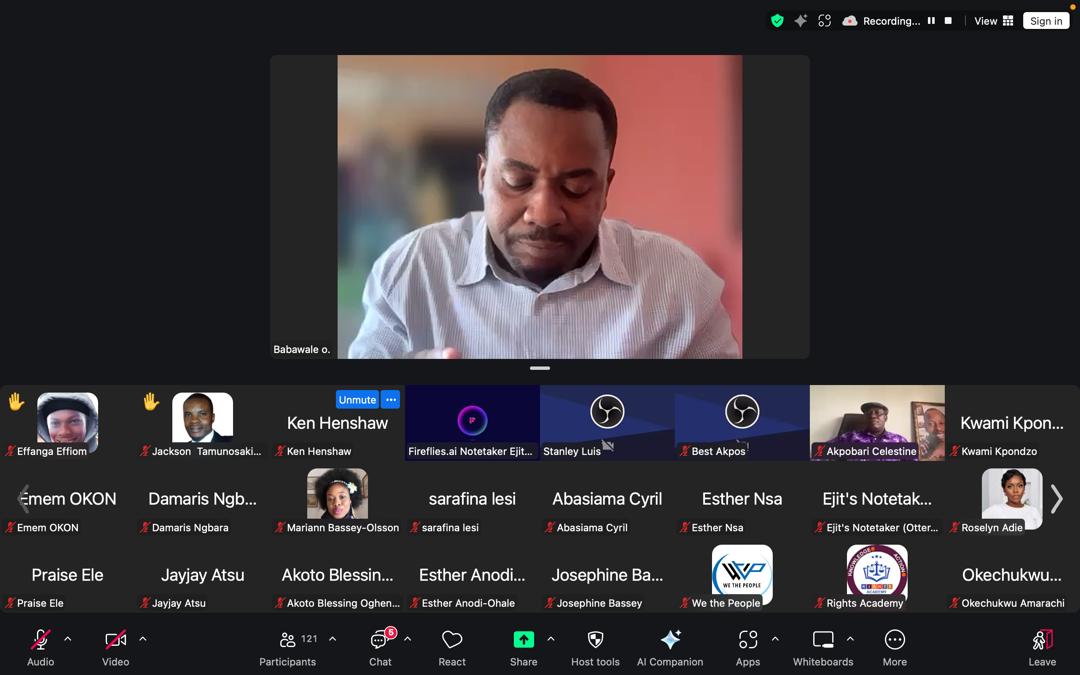
On Monday, July 24th 2026, We the People partnered with Environmental Rights Action (ERA) and Miideekor Environmental Development Initiative (MEDI) for a webinar tagged, “Beyond Ogoni Cleanup: Imperatives for an All-Niger Environmental Restoration”. For over 7 decades, oil and gas extraction in the Niger Delta has resulted to contaminated farmlands, destroyed mangroves and have threatened livelihoods and health of the over 40 million people living in the region. From the United Nations Environment Programme (UNEP) report, to the Bayelsa State Oil and Environmental Commission and recent scientific investigations in Otuabagi, Bayelsa State by Kebetkache Women Development and Resource Centre, all affirm the environmental and public health crisis faced by the region. The webinar brought together environmental justice activists, researchers and community advocates to interrogate a fundamental question: Can Ogoni be meaningfully cleaned up while oil pollution continues across the wider Niger Delta? What would a truly Pan-Niger Delta clean-up look like?
Ken Henshaw, Executive Director of We the People, started the discussion, referring to the 2011 United Nations Environment Program (UNEP) assessment of Ogoniland, which stated that soil, groundwater and surface water were widely contaminated. The assessment found benzene levels in drinking water well above acceptable standards and damage to mangroves, creeks and fisheries. UNEP estimated that remediation could continue for 25-30 years to restore Ogoniland. Henshaw also pointed to environmental assessments from Bayelsa State and a more recent community-led assessment in Otuabagi, saying Ogoniland is just a small part of the much larger Niger Delta. He asked why the government waited for international bodies to confirm environmental devastation before taking action, and called for a systematic evaluation of contamination throughout the region.
The Executive Director of Miideekor Environmental Development Initiative, Celestine Akpobari, posited strongly that the Ogoni cleanup is the result of struggle, not government benevolence. He recalled the battle against the earlier UNEP assessment report, which activists criticized for blaming communities while letting oil companies off with only a back pat. The lesson for Akpobari is simple– government responds when citizens mobilize and put pressure on them. He said the interlinked waterways of the Niger Delta mean pollution cannot be contained within administrative boundaries. “Every part of Niger Delta must be clean,” he insisted, adding that oil companies, government and companies that have acquired divested assets must be made to restore the environments they have damaged. Akpobari further called for renewed grassroots mobilization, including street action, saying the ongoing Ogoni cleanup itself was won through sustained resistance and sacrifice.
Babawale Obayanju, Executive Director, Tell that Story, went further to emphasize the ecological inter-connectedness of Niger Delta communities. He said water, air, plant life, animals and other ecological systems tie communities together. So, it is possible to clean one place and let the pollution continue elsewhere and thus continue contamination. He said the attention generated for the Ogoni struggle should be extended to other oil producing communities in Rivers, Bayelsa, Delta and Akwa Ibom States and other affected areas. He also warned that another challenge was the continued divestment by international oil companies. As assets are transferred to indigenous operators, communities will need to ensure that divestment does not become a way for companies to offload environmental liabilities. He called for improved evidence gathering, new organizing and strategic alliances capable of holding both old and new operators to account.
The conversation shifted from environmental contamination to the human body, said Dr. Emem Okon, Executive Director of Kebetkache Women Development and Resource Centre. She referred to the Otuabagi study where 80 women were tested for hydrocarbon exposure and all of them tested positive for polycyclic aromatic hydrocarbons in their blood. Communities eat contaminated fish, drink and irrigate with oil-polluted water, and residents and environmental workers may come into direct contact with crude oil without proper protective equipment. The result, she said, is that environmental contamination has become a public health crisis. She in particular pointed out the gendered aspects of pollution, including the possible reproductive health impacts, and the psychological toll women are taking on themselves in having to worry about what pollution might be doing to their bodies. Emem called for health testing in affected communities, more scientific evidence, and a full assessment of what needs to be restored.
The conversation eventually moved from whether the Niger Delta should be cleaned up, to how the demand can be a political reality. Participants asked questions about how the wider program could be financed and monitored and questioned the funding and slow pace of the existing Ogoni cleanup.
Henshaw, in his concluding remarks, said the success of the Ogoni struggle demonstrates the power of communities and allies organizing around a common cause. He said the same solidarity should now bind communities across the Niger Delta and with environmental justice movements around the world. The webinar ended with a strong call for renewed organizing, better evidence, health and economic assessments, political pressure and accountability for both government and oil companies.