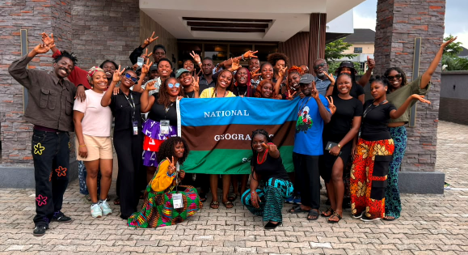
From 22nd to 27th June 2026, National Geographic Society in partnership with We the People and supported by the Ford Foundation hosted the National Geographic Photo Camp in Port Harcourt, Rivers State. The 5-day intensive program, themed “Oil Extraction in the Niger Delta”, brought 20 young participants from the region to learn photography, writing and visual storytelling while documenting one of the world’s most environmentally significant and contested regions. The National Geographic Photo Camp is a global program that empowers young people to use visual storytelling to understand their communities, elevate local voices and inspire action. The program moves beyond learning photography, to teach participants how to see deeply, tell compelling stories and work ethically with the people whose lives they document. Over the period, participants experienced hands-on learning from experienced National Geographic facilitators that included classroom sessions and field experiences that challenged participants to think critically about storytelling, environmental justice and the responsibility that comes with documenting real people’s lives.
Beyond the classroom learning, the photo camp placed participants in communities whose stories have been shaped by oil extraction, environmental degradation, resilience, and resistance for a long time. Participants worked in groups of five to brainstorm story ideas, sharpen their interviewing and photography skills, and learn how to tell stories that put people, not just problems, at the center.
The first field visit took the participants to the Okrika Waterside Community in Port Harcourt Local Government Area. For many of the young storytellers, this was their first exposure to a community whose history is one of collective resistance to repeated attempts to tear down homes and displace residents. After years of uncertainty, the community is still fighting for its right to exist. Mr. Michael Uwemedimo, Director of Chicoco Radio, a community media platform established to support residents in telling their own stories and organizing resistance to forced evictions, welcomed the participants. Community members engaged in conversations, providing participants valuable insight on the power of community-led media and storytelling as tools for advocacy and social change. After the brief talk, participants spread out into the community to be with residents, engage with their stories, and started documenting everyday life through photographs and interviews.
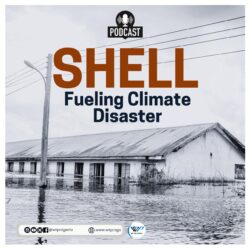
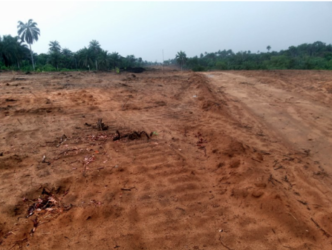
The second field visit was to Ogale Community in Eleme Local Government Area, one of the communities most affected by decades of oil pollution. The participants were welcomed by His Royal Highness, King Godwin Bebe Okpabi, the Paramount Ruler of Ogale Kingdom, who narrated the extraordinary story of how some 40,000 affected communities came together to take Shell to court in the United Kingdom for massive environmental pollution as a result of the years of crude oil extraction. Participants were able to hear from the traditional ruler directly and gain a greater insight into how communities continue to seek justice through legal advocacy after years of environmental degradation. Thereafter, participants also visited Hydrocarbon Pollution Remediation Project (HYPREP) remediation sites where continued clean-up work is underway to restore contaminated land and water.
The last community visit saw the participants visit Rumuekpe Community in Emohua Local Government Area. Rumuekpe has a history of violent communal conflict over oil and gas operations, leaving deep social and economic scars. But the community is also resilient. Despite the painful memories arising from the conflict, the community have become more determined to rebuild trust, strengthen ties and build a better future. Through talking, taking photographs, and watching, participants documented stories that revealed not just hardship, but healing, reconciliation, and hope. It was an important reminder that the Niger Delta is not only a site of crisis but also a site of resilience, courage, and renewal.
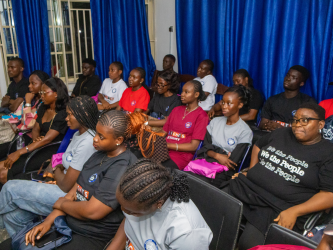
National Geographic facilitators mentored the camp intensively, teaching the participants about photography, writing, editing, visual ethics, narrative development and collaborative storytelling. The participants’ confidence grew to create individual photographs with strong visual storytelling, combining impactful images with reflective writing. The collaborative space fostered creativity, curiosity, and critical reflection, enabling participants to see storytelling as not only an artistic pursuit but also a means for social impact. The week culminated in a colourful Showcase Day where participants shared their completed photo stories with an audience of family, friends, mentors, community representatives and invited guests. Each presentation was a window into the different perspectives that participants cultivated throughout the camp– encapsulating stories of environmental justice, community resilience, cultural identity, and daily life throughout the Niger Delta. The showcase was a celebration of the technical accomplishments in photography and storytelling, and the confidence participants had gained in using their voices to document issues that matter.
By the time the 2026 National Geographic Photo Camp concluded, participants had walked away with much more than just new technical skills. They left with a deeper understanding of the Niger Delta, stronger ties with each other and a renewed appreciation for the power of ethical storytelling. For the National Geographic Society, Ford Foundation and We the People, the Photo Camp was a reaffirmation of a shared commitment to invest in young storytellers who can document their communities with honesty, empathy and integrity. The stories we created throughout the week are a reminder that behind every discussion on oil extraction, there are real people, real communities and real hopes for a more just future. The Photo Camp put cameras–and trust– into the hands of young people, making sure that the next generation isn’t just seeing history, but helping to shape how it will be remembered and understood.