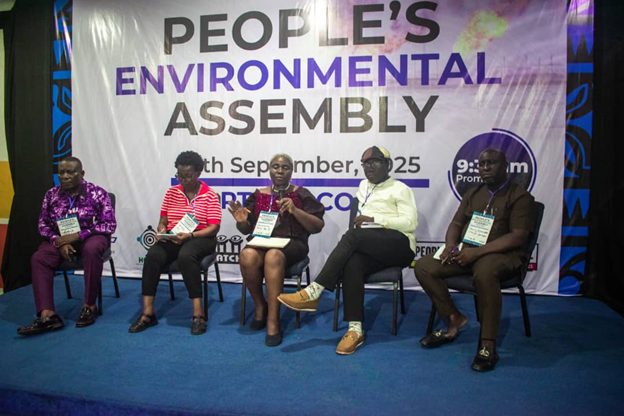
On September 26, 2025, We the People and partners held the first People’s Environmental Assembly, a space to articulate and campaign around localised challenges associated with ecological damage caused by oil and gas extraction and climate change in Nigeria, particularly the Niger Delta, including how they manifest in health problems and loss of livelihoods. The Assembly also provided a platform for discussing these consequences, as well as the roles and duties of each perpetrator and their collaborators.
In his introductory remarks, Ken Henshaw, Executive Director of We the People, stated that the Niger Delta is one of Nigeria’s most impoverished regions and one of the most polluted in the world. According to him, multiple oil spills from pipelines operated by international oil companies have caused degradation to the environment, economic stagnation, and health problems for the region’s population. This has resulted in a number of negative indicators for the people, including the fact that the region’s life expectancy is significantly lower than the national average, at 41 years, and that people are far more likely to suffer from respiratory illnesses and cancers than elsewhere in the country, while women are more likely to have miscarriages and give birth to deformed babies. Over the last 70 years, crude oil and gas extraction has had a substantial impact on the Niger Delta’s underdevelopment. He expressed frustration that, despite the obvious and recorded harmful effects on people and the environment, oil companies such as Shell, Exxon-Mobil, Eni, Total Energies and Chevron have rarely been held accountable for the region’s damage.
Dr. Kavian Kulasabanathan of the People’s Health Tribunal Collective delivered a lecture titled The People vs Shell: The Health Case for Resistance, in which he discussed Shell’s colonial and repressive history, as well as how it used colonial dominance to extract crude oil in Nigeria without the consent of the indigenous people. According to him, Shell has perfected tactics that allow it to continue profiting while paying little to no regard to environmental hazards or human health. These techniques have primarily included purposeful ignorance, contestation of facts and knowledge, shifting blame to communities, making false promises, divide and rule to weaken organised resistance, strategic impoverishment and exhaustion, and direct repression supported by state military might. He referenced the 2011 United Nations Environment Programme report on oil contamination in Ogoniland, as well as the 2023 Impact of Oil Spill on Women in Bayelsa State report, as overwhelming evidence that Shell committed ecocide against the Niger Delta people.
Professor Chris Akani, a traditional ruler and university lecturer, gave historical narratives of the Niger Delta people’s struggles against environmental destruction caused by oil exploitation. According to him, the extraction of oil and gas was an imposition on the people, and it was never done with their consent. He went on to say that the Ogoni and Umuechem people’s resistance in the early 1990s, as well as the struggles of various other Niger Delta resistance movements, demonstrated the people’s rejection of the destruction of their lives and environment. However, oil companies have always had the support of the state and its security apparatus.
The Assembly also laid the framework for promoting global solidarity among victims of hydrocarbon pollution and climate change, with the goal of initiating ongoing interaction with other victimised people around the world in order to establish a network of victims dedicated to fighting for accountability and justice. A panel discussion included an exchange of perspectives on the oil accountability struggles in Nigeria and South Africa. The Assembly reached its conclusion with the formulation of a popular petition for ecological justice, as well as an agenda for long-term initiatives to meet those objectives.