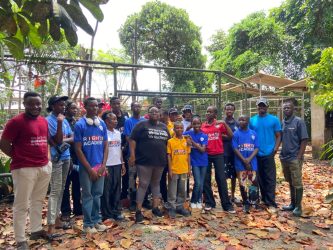
On Thursday, 2nd July 2026, We the People convened community leaders, media, and civil society organizations from forest host communities across Cross River State for a capacity-building workshop aimed at strengthening community leadership in forest protection and advancing the rights of forest-dependent communities. Cross River State, once celebrated for its vast tropical rainforests and rich biodiversity, is facing increasing pressure from logging, mining, land grabbing, and other extractive activities that continue to threaten its forest ecosystems. Despite being the traditional custodians of these forests, host communities have often been excluded from decisions affecting their lands and livelihoods. The workshop was organized to reaffirm the vital role of local communities in forest governance while equipping participants with the knowledge and tools needed to protect their forests and advocate for their rights.
Nsikak Udofot, Program Officer at We the People, opened with a session on the importance of forests to both local communities and the global climate. He highlighted that forests are far more than collections of trees—they provide food, medicine, clean water, livelihoods, and cultural identity for Indigenous Peoples and forest-dependent communities, while serving as critical carbon sinks that regulate the Earth’s climate and support biodiversity. He emphasized that the continued destruction of forests threatens not only ecosystems but also the survival and wellbeing of the people who have depended on them for generations. Drawing on the long history of community stewardship, he stressed that effective forest conservation must be community-led, recognizing Indigenous Peoples and local communities as the forests’ most enduring custodians and placing their knowledge, rights, and leadership at the center of conservation efforts.
Ken Henshaw, Executive Director of We the People, followed with a session on the historical evolution of forest governance in Nigeria and Cross River State. He explained that before colonial rule, forests were largely managed under customary systems where communities exercised collective ownership and stewardship based on traditional laws and practices. Colonialism fundamentally altered this relationship by transferring control of forests to the state, introducing restrictive forestry laws that prioritized timber extraction and government revenue over community rights. He noted that many of these centralized governance structures persisted after independence, continuing to limit community participation in forest management and decision-making while weakening customary systems that had sustained the forests for generations.
Recognizing that the challenges facing forest communities in Cross River are part of a wider global struggle, Grace Appolos, Programs Manager at We the People, led a session on community-led forest movements around the world. Drawing examples from the Amazon Basin, the Congo Basin, and the forests of South Asia, she highlighted how Indigenous Peoples and forest-dependent communities have organized to resist destructive logging, mining, land grabbing, and other threats while advancing community rights and sustainable forest governance. She also introduced participants to regional and international networks that support forest defenders, encouraging the Forest Host Communities Network to build alliances beyond Nigeria, strengthen collective organizing, and leverage global solidarity to amplify their advocacy for community rights and forest protection.
The workshop also strengthened participants’ capacity for grassroots advocacy through a session facilitated by Kebe Ikpi, a community advocate, who introduced practical approaches to documenting environmental violations, gathering credible evidence, and engaging legal, media, and advocacy mechanisms to demand accountability. He emphasized the importance of communities systematically documenting changes in their environment through photographs, videos, written records, testimonies, and location data, noting that such documentation not only preserves the history of environmental degradation but also provides vital evidence for future litigation, advocacy campaigns, and policy engagement. He encouraged participants to become active custodians of their own stories rather than relying on external actors to document their realities. During the interactive session, participants worked collaboratively to develop community statements highlighting the environmental challenges affecting their forests and identifying collective actions they could take to strengthen forest protection and community organizing.
By the end of the workshop, participants had gained a deeper understanding of the environmental, legal, and social dimensions of forest governance and left with practical skills to strengthen community action. More importantly, the gathering reinforced a shared commitment to ensuring that the people who have protected Cross River’s forests for generations remain at the centre of decisions about their future, recognizing that sustainable forest conservation is only possible when community rights are respected and protected.
The workshop concluded with the presentation of a work plan for the Forest Host Communities Network, outlining priorities for the coming year and encouraging stronger collaboration among member communities. Participants committed to improving documentation of environmental threats, strengthening community mobilization, expanding advocacy efforts, and promoting greater awareness of community rights under existing legal frameworks.